
Faster decisions that actually hold is a deceptively simple promise. Every leadership team wants it. Most don’t have it — not because they lack intelligence or information, but because speed and durability pull against each other in ways that rarely get examined directly. A team that decides fast by shutting down debate gets speed without buy-in. A team that chases full agreement before moving gets buy-in, eventually, at the cost of everything a decision loses by arriving late.
The teams that manage both aren’t simply more decisive by temperament. They’ve built something specific: enough trust to disagree honestly, a shared discipline for actually closing a decision once it’s made, and — less obviously — a set of underlying skills that sit squarely inside what emotional intelligence models like EQi 2.0 class as Decision Making. Good decision making turns out to be less a trait and more a skill set. That matters, because a skill set can be built.
What’s actually happening when decisions stall or don’t hold
There are two distinct failure modes here, and most teams have a dominant one rather than both. The first is stalling: a decision that never quite gets made, referred upward one more time, held open for one more round of input, delayed in the name of being thorough when it’s really being delayed out of discomfort with the call itself. The second is failing to hold: a decision gets made cleanly enough in the room, and then quietly comes apart afterwards — relitigated in corridor conversations, undermined by people who nodded along but never actually agreed, or simply not executed with any real urgency because nobody in the room ever truly owned it.
Both look, from a distance, like a decision-making problem. In practice they’re usually a trust problem and a discipline problem wearing a decision-making disguise — which is exactly why fixing them needs more than a better process template.
Where it goes wrong
Five patterns account for most of the damage, and they show up in teams who are otherwise perfectly capable:
- Mistaking speed for decisiveness. Moving fast by cutting off real disagreement feels efficient in the room and expensive afterwards — the objections that never got raised don’t disappear, they resurface later as resistance.
- Chasing consensus instead of commitment. Waiting for everyone to genuinely agree is a different thing from asking everyone to commit to the call regardless. Teams that confuse the two either wait far too long, or quietly settle for agreement that was never actually there.
- Letting the most senior voice decide by default. When a decision is really made by one person while appearing to involve the room, the team disengages from executing it — because they never owned it in the first place.
- Deciding without separating fact from assumption. Jumping straight to judgement, before properly testing what’s actually true versus what simply feels true, is how confident teams make decisions on the wrong information.
- Failing to build in a genuine stop. Without real discipline for closing a decision — stating plainly what was decided, by whom, and from when — the conversation just trails off. Nobody’s quite sure if it’s final, so it drifts back open the moment it gets difficult.
What the EQi 2.0 model means by Decision Making
EQi 2.0, one of the psychometric tools we use regularly in this work, groups emotional intelligence into five composite scales — and Decision Making is one of them, made up of three specific, measurable skills:
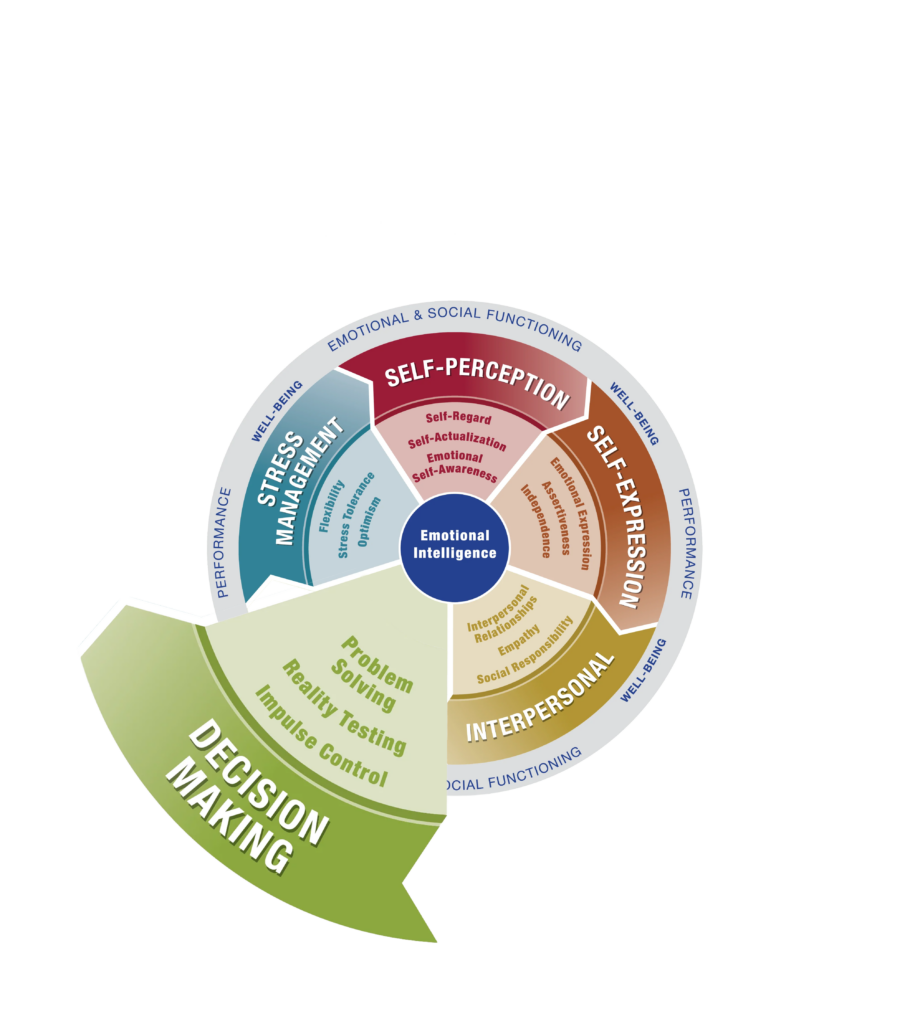
Seen this way, a leadership team’s decision-making problems are rarely about intelligence. They’re usually about one of these three skills being under-developed under pressure — a team strong on problem solving but weak on reality testing will decide confidently and be confidently wrong; a team strong on reality testing but weak on impulse control will see the situation clearly and still jump to the wrong call anyway.
What good decision making actually looks like
A team deciding well still has real debate before the call gets made — that part doesn’t disappear, and shouldn’t. What changes is the discipline around it: the leader is explicit about which mode the room is in — gathering views, or deciding now — so people aren’t caught arguing a point after the moment for it has passed. The decision itself gets stated plainly, including what was actually agreed and why, so there’s nothing vague left to quietly reopen later.
We find a team’s real decision-making pattern becomes visible fastest outdoors, under genuine pressure — a call about route, pace or weather, made with incomplete information and a real consequence attached. Who reaches for more data than the moment allows. Who jumps straight to the first workable option. Who checks what’s actually true against what simply feels urgent. It surfaces in minutes what a boardroom conversation can take months to reveal, and because everyone sees it happen together, it’s immediately something the team can actually work on, rather than a trait anyone gets quietly blamed for.
This is the outcome behind our “faster decisions that actually hold” promise, and it’s what our Decision Making and Problem Solving work is built around directly. The “carry it through afterwards” half of that promise leans heavily on genuine commitment, which we’ve written about in Stage Three: Norming and which sits at the centre of Lencioni’s Five Dysfunctions of a Team — the two ideas are really the same problem, seen from different angles.
Leave a Reply